Showing posts with label branding. Show all posts

Tuesday, 13 August 2013

His master's tone of voice

This recent Marketing Week post on corporate tone of voice caught my eye. This figure is particularly striking — "brands [globally] spend $13bn (£8.7bn) a year on visual identity and just $2bn on verbal identity" — but it's encouraging to read of brands like O2 and Nationwide taking the war on jargon more seriously (especially as I'm a customer of both).

I wouldn't say O2's 'be more dog' billboards tell us anything useful about the clarity of the company's communications, though: the test is how easily customers can read small print and speak to call centres, not what they take from an abstract ad campaign. Attending to those small details might not win many headlines or awards, but it will help a brand quietly build a good reputation. Equally, we shouldn't assume that because a company's outlook is irreverent and unfussy it necessarily produces clear, consistent messages or makes the most effective use of communication channels. Corporate mission statements that read like Facebook status updates tend to grate.

A common complaint is that the language organisations use is often shaped by backroom technicians rather than frontline communicators, who end up having to work as translators so the public can understand what their colleagues are on about. If it's not possible to involve sales and marketing staff in the terminology process from the start of a project, it can at least help to have a comprehensive style guide that acts as a jargon-to-plain English dictionary.

This is all particularly true on social media. Corporate communicators are nowadays encouraged to speak to customers in their own language online; this is sensible, but it requires a solid grasp of who those customers are and what their language is like. As with every other aspect of the internet, risks and potential rewards are both magnified.

A final related point is that marketing folk tend to be more aware of the need to avoid jargon than senior management, who often need to be persuaded of the value of both plain English and social media. The best managers are instinctively open to such developments, won't treat them as tick-box exercises and will both invest and take part in relevant training: but this is more proof that good external communication depends on good internal communication.

Brands that aren't aware of these issues often end up annoying the public and losing customers. Now, why not have a look at a fellow comms guru's advice on a few things firms can do to avoid annoying journalists and losing press coverage?

Friday, 26 July 2013

The open society and its enemies

Thrill-a-minute hedonist that I am, I've spent the week reading Facts are Sacred, the Guardian's new book on data journalism, and The Signal and the Noise by clever clogs Nate Silver. The usual low standards of Guardian subbing are met, but ignoring that there's some interesting content. I note that the New Statesman, New Scientist and several marketing magazines have also devoted recent front covers to big data.

Nate Silver is impressive on the limitations of data; what he really advocates is an approach combining both quantitative and qualitative analysis, as well as a Bayesian method of improving one's probabilistic forecasts as the evidence changes. His advice — again, equally applicable to anyone in business, politics, communications or journalism — is to be consciously aware of your own biases if you want to overcome them and see the situation objectively. You hardly need me to add to the mountains of textbooks already written on how institutional groupthink and inertia have brought down many once-mighty companies. The challenge is to constantly apply this scepticism to your own positions.

At the risk of coming over all Blairite, there is also an open/closed distinction at work here, and the point applies as much to mindsets as datasets — and it cuts completely across traditional left/right or even liberal/conservative lines. As a recent Economist piece put it: "Our ideological sympathies are not good predictors at this point of how we feel about issues of digital privacy and electronic freedom. The fact that these issues don't have a clear ideological colouration yet is important because they are among the most crucial issues of the 21st century."

I would summarise this as the division between those whose instinct is to make information more widely available, and those whose instinct is that it should remain the preserve of responsible gatekeepers of knowledge — between:


We could list more examples, but the point is that this battle against banal illiberalism will define the era of big data and big brothers. Those of us working in communications are at the frontline, so we might as well get ourselves on the right side. If you're a journalist: understand how data can be used both to find and to illustrate stories, carefully craft and submit FOIs,1 resist the lure of churnalism; if you're in PR or marketing, convince your bosses to make openness and clarity an integral part of your brand, develop a responsive social media presence that makes this a reality, and never let the cover-up eclipse the crime.

As YouGov's Peter Kellner says: "knowledge is not only preferable to ignorance in principle; it also makes for a healthier society in practice". Encouragingly, one of the 10 design principles on the new gov.uk site is: "Make things open: it makes things better." What we really need is for this message to filter up to ministers and senior civil servants, and down to middle managers.

The point isn't that we need to be anti-capitalist or anti-government in principle; just that, to make both of these essential parts of our society work better, we need to keep a close eye on them from inside and out. As citizens we have to hold public bodies and global companies to account every bit as ruthlessly as we hold producers to account when we choose whether or not to buy their goods and services. As employees we need to fight institutional cultures that prioritise the organisation above the consumer or the public.

Erring on the side of this openness is good for society; whether it's good for individuals is an entirely different question.

1 I recently did this in my capacity as an elected member of Dowanhill, Hyndland and Kelvinside Community Council, and after waiting nearly a month was told by Glasgow City Council I'd need to pay a fee of £90 to get the answer I was looking for. But don't let that put you off. ;-)

Wednesday, 17 April 2013

The political scientist

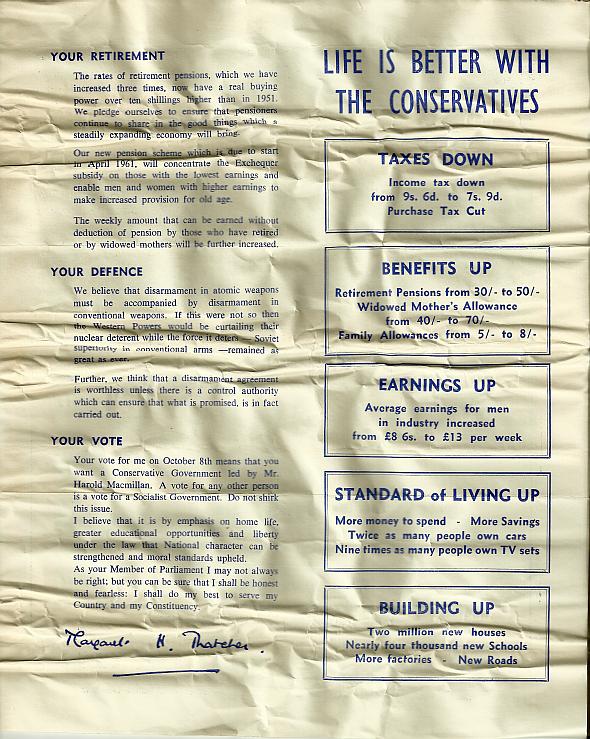
After Margaret Thatcher died, this leaflet from her third (but first successful) parliamentary campaign did the rounds on Twitter:

As an editor, I can't help noticing that there are four pages of the stuff, not to mention the usual assortment of random and pointless capitalisations (some things don't change).

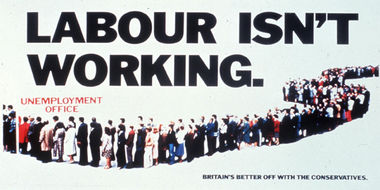
I doubt, by the end of her political career, she would have stood on a platform of 'BENEFITS UP' — but I think, policy aside, it tells us a lot about how political communication changed in the second half of the 20th century.  Fast forward to her leadership of the Conservative Party and her time as prime minister, and compare her first endearingly amateur leaflet with these very influential, clear and direct adverts.  First, the Saatchi campaign that got her elected:


Then the advert I most associate with her time in office, 'AIDS: Don't Die of Ignorance':


We don't tend to think of Thatcher as one of the great political communicators — admirers and detractors both point more to her unshakeable ideology and her force of personality as the secrets of her success — but we might remember how much of the professionalised media management Blair, Mandelson and Campbell perfected in the New Labour era began with her and her press secretary Bernard Ingham.  Perhaps, also, her dislike for nuance, subtlety and intellectual contortion allowed her to present simplified, easily understood messages in a way that has often eluded highbrow leftwing opponents.

The one epitaph being consistently applied by both friends and enemies is that 'you always knew what she stood for'.  In politics I'd prefer to live by Keynes' maxim, and my instincts would always favour consensus over a 51% strategy: but we can't deny the power that the Thatcher brand held for so many people for a remarkably long time.  The appeal of that uncomplicated approach, and the way her image personified her ideas, surely holds lessons for today's corporate and organisational communicators.  Like Supermac, and in a way her biggest rivals Tarzan and the Welsh Windbag never matched, the Iron Lady embraced an opponent's epithet and turned it greatly to her own advantage.

However, I think today marks the moment the brand overreached itself; achieved Thatcheration point.  A ceremonial funeral (a state funeral in all but name), complete with several hundred serving members of the armed forces, a cancellation of PMQs and a silencing of Big Ben, seems to me fitting only for a head of state, not a former head of government.  That conservatives fail to grasp the difference shows the hold she still has on their worldview.

I hope, then, I won't upset anyone by suggesting that now is the time to lay the brand to rest, not to immortalise it.

Tuesday, 15 January 2013

Dearly departed

The Economist has a good blog on airport names this week, pointing out the trend for naming them and other key bits of infrastructure after famous locals. If Birmingham is seriously considering renaming theirs after Ozzy Osbourne, the genre would seem to have jumped the shark.

In Glasgow, we now have the Sir Chris Hoy Velodrome. Clearly, on one level this makes sense, as he is not just Scotland's greatest cyclist but Britain's greatest Olympian (who also has a train named after him already). But there's still something about the trend that bothers me.

It's not just that the man strikes me as modest enough to be embarrassed by it (though we should be thankful for that: imagine if they were naming a stadium after Usain Bolt instead). It's also not just that he hasn't even retired yet (what if he competes there in 2014 and flops?) let alone died, which I think should be a minimum qualification for supplying the name of anything noteworthy. It's not hard to think of examples of famous people who have fallen from public grace towards or soon after the end of their lives or careers — not even hard in the realm of cycling — so the authorities will always be leaving themselves hostage to fortune.

It's not just the aesthetics either: compare JFK with its evocative former name, Idlewild. There may be a case for commemorating a few particularly great individuals — I would grudgingly accept Charles de Gaulle, I suppose — but there's not much poetry to be derived from the names of people. Imagine if every London Underground station were instead named after a well-known local: no more Swiss Cottage, Seven Sisters or Gallions Reach. It would be a sad loss to a small but distinctive part of our culture.

More than that, though, it's the idea that society can't really get along without particular individuals, which seems a depressingly authoritarian view of the world, and one that suggests an ahistorical lack of continuity with past and future generations: with the greatest respect to Sir Chris, soon enough he will mean little more to the latter than he did to the former. Nasty dictators still name not just their buildings but even their days of the week after themselves. Augustus did the same with the calendar in his time.

It seems to me a trend that, if we want to see ourselves as egalitarian and democratic — respectful of our heritage but free-thinking and free-naming — we ought to leave in the departure lounge.

Tuesday, 6 November 2012

Period drama

As our American cousins go to the polls, readers of this blog need not fear that important issues like full stops and exclamation marks have been overlooked in the campaign.

And yet, the best communicators are like field marshals, attending to the broad sweep of rhetorical strategy as well as the details of syntax and orthography. Obama was praised for just such 'soaring oratory' in 2008, though inevitably there's been less sign of that this time.

In the end, the result will probably come down to which candidate has done a better job of framing the language used to describe his policies, record and background — and surely no-one can seriously think that leaves us with Mitt '1%' Romney.

Friday, 3 August 2012

The cuts

This story illustrates a couple of rules about cutting and pasting — an issue I encounter all the time in my job as an editor.

First, make sure you're clear about:

  • what text you're cutting
  • where you're cutting it from
  • where you're pasting it to (you'd be surprised how often these first three are overlooked)
  • whether copyright rules allow you to do so
  • whether it might be better to use new text instead

Second, if you fail to take note of any of these points: make sure there's no chance that the people reading the passage in the original and those reading the copy will compare notes. (This happened to me at university once, when our lecturer gave identical feedback to me and two other students even though we'd written completely different proposals for a piece of work. He ended up looking a bit foolish, at least to us.)

This story also illustrates a point in my earlier blog about confusing nomenclature. Why is the company carrying out inspection reports on Ofsted's behalf called Tribal? It may be that they carry out all sorts of other functions, but in what way does that name describe any of them?

Compare this to, say, the Worshipful Company of Spectacle Makers or (a favourite of mine) the Scottish Association of Master Bakers: you need no information beyond their name to work out what they do for a living. Is Tribal's obfuscation an unfortunate side-effect of trying to sound hip and modern, or part of a deliberate effort to make the important work they do less transparent?

Similarly, compare Ofsted with Her Majesty's Inspectorate of Education, which we still had in Scotland until recently, though always shortened to HMIe. The 'Of-' prefix for official bodies (Ofgem, Ofqual, Ofwat) has become almost as much of a cliche as the '-gate' suffix for political scandals. HMIe is now part of Education Scotland, itself part of the trend towards replacing adjectives or verbs with nouns in names of organisations. Compare Scottish Rugby Union (founded in 1873) with Scotland Rugby League (founded in 1997).

The message remains the same: whenever you use a word — whether as part of a written or spoken sentence, or as a proper noun in a name — it's always worth considering whether there's a clearer one you could use instead.

Thursday, 26 July 2012

Band words


I enjoyed this recent tale of a communications breakdown (which also features the British jobsworth, a stock character in these situations). The confusion about '4am' is perhaps a forgivable result of the trend for misleading monikers in popular culture. The sturdy [definite article + plural noun] formula for band names — which gave us the Beatles, the Animals, and so on — has long gone out of fashion.

In my youth it was replaced by single short words: Blur, Oasis, Verve, Cast, Muse. As musical tastes have fragmented since then, so have the names performers give their acts, as a glance at any advert for a music festival shows.

One of the common themes now, though, is for bands to advertise themselves as some sort of unrelated organisation: Mull Historical Society, the Victorian English Gentlemens Club, Bombay Bicycle Club. I don't know whether it's a coincidence that these names all share a hint of wistful romance.

It's easy to laugh at the police and council for their reaction in this case, but one can see why 'music from 4am' could be a bit misleading. It also, I think, shows the importance to new acts of choosing a really cool name: would the Rolling Stones, or Motörhead, or Iron Maiden, have ended up playing in stadiums around the world if the most basic part of their brand was less impressive? Or would they still be playing to council officials in village pubs in Surrey?