Showing posts with label posters. Show all posts

Wednesday, 17 April 2013

The political scientist

After Margaret Thatcher died, this leaflet from her third (but first successful) parliamentary campaign did the rounds on Twitter:
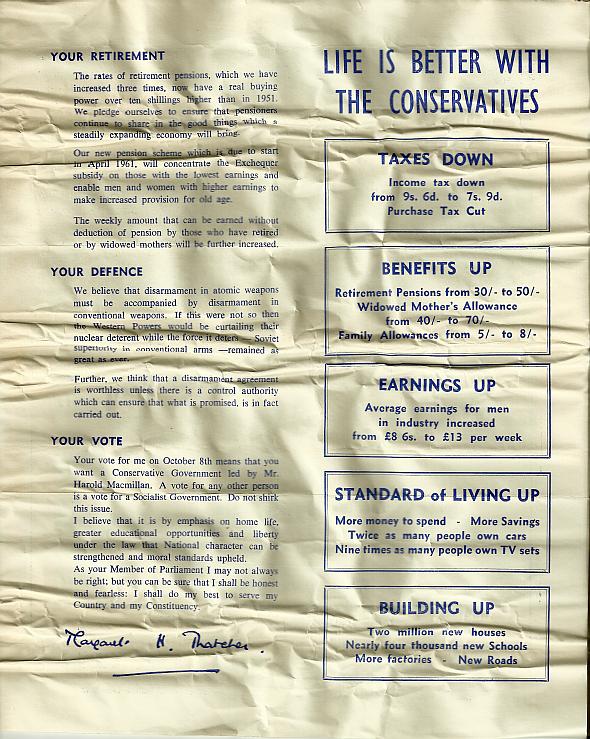
As an editor, I can't help noticing that there are four pages of the stuff, not to mention the usual assortment of random and pointless capitalisations (some things don't change).

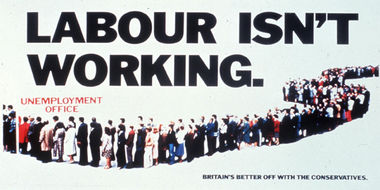
I doubt, by the end of her political career, she would have stood on a platform of 'BENEFITS UP' — but I think, policy aside, it tells us a lot about how political communication changed in the second half of the 20th century.  Fast forward to her leadership of the Conservative Party and her time as prime minister, and compare her first endearingly amateur leaflet with these very influential, clear and direct adverts.  First, the Saatchi campaign that got her elected:

Then the advert I most associate with her time in office, 'AIDS: Don't Die of Ignorance':


We don't tend to think of Thatcher as one of the great political communicators — admirers and detractors both point more to her unshakeable ideology and her force of personality as the secrets of her success — but we might remember how much of the professionalised media management Blair, Mandelson and Campbell perfected in the New Labour era began with her and her press secretary Bernard Ingham.  Perhaps, also, her dislike for nuance, subtlety and intellectual contortion allowed her to present simplified, easily understood messages in a way that has often eluded highbrow leftwing opponents.

The one epitaph being consistently applied by both friends and enemies is that 'you always knew what she stood for'.  In politics I'd prefer to live by Keynes' maxim, and my instincts would always favour consensus over a 51% strategy: but we can't deny the power that the Thatcher brand held for so many people for a remarkably long time.  The appeal of that uncomplicated approach, and the way her image personified her ideas, surely holds lessons for today's corporate and organisational communicators.  Like Supermac, and in a way her biggest rivals Tarzan and the Welsh Windbag never matched, the Iron Lady embraced an opponent's epithet and turned it greatly to her own advantage.

However, I think today marks the moment the brand overreached itself; achieved Thatcheration point.  A ceremonial funeral (a state funeral in all but name), complete with several hundred serving members of the armed forces, a cancellation of PMQs and a silencing of Big Ben, seems to me fitting only for a head of state, not a former head of government.  That conservatives fail to grasp the difference shows the hold she still has on their worldview.

I hope, then, I won't upset anyone by suggesting that now is the time to lay the brand to rest, not to immortalise it.

Thursday, 21 March 2013

Health prevention of literature

A co-conspirator sent this image in from his place of work:
'It seems like no matter what nationality you are, the slide into stale painting-by-numbers corporate lingo is exactly the same,' he added. Very well put, which is more than we can say for whoever produced the unfortunate poster.

Still, as health advice goes, it's not as disturbing as this sign I saw in Singapore a couple of years ago:
I think that rivals the KEEP OUT: DANGER OF DEATH sign I saw on an electricity substation in Plockton for the least appropriate use of Comic Sans yet.

Friday, 1 March 2013

Tricolon cancer

It seems classical rhetoric has a place in modern communication strategy after all. Have a look at Cancer Research's use of omne trium perfectum in this new poster I saw on the underground this week: I think it works very nicely. They're also taking Owen Jones' advice and telling stories rather than quoting a bunch of boring facts and stuff.


A lot of charities have turned into political lobbying machines and so become distrusted by a jaded public; the more organisations like Cancer Research can show that they stick to their basic purpose, the more they can convince us to fund them. I think campaigns like this will certainly help.

Tuesday, 8 January 2013

Deconstructing dog whistles

Today I noticed a piece of political communication that raised my eyebrows: this one-day poster campaign by the Tories to highlight Labour's support for the government's 1% cap on public sector wage rises (a cut, in real terms) but opposition to the government's 1% cap on rises in benefits.


You might think I'm being pedantic (it is my job, after all) but I think what they've come up with doesn't quite come off.  When you have as few words as this to play with, as will always be the case in a billboard poster, the message needs to be totally unambiguous, and I don't think this is.

The 'by' makes it fall down: it suggests Labour support putting up benefits by an amount greater than workers' salaries, which obviously isn't the case.  On realising it's not the case, the floating voter on the Clapham omnibus might then find himself wondering why the Tories had put up such a misleading poster, and ask himself what else he can't trust them to be straight about.  It also raises the question: which workers?

My suggested wording (assuming that mentioning a 'cap' would be too Westminster villagey) would be as follows: 'Labour want to cut public sector wages. They don't want to cut benefits', perhaps followed by 'Only the Conservatives stand up for hardworking people.'  This leaves out that the government also want to cut public sector wages, so is perhaps a bit more ruthless, but also I think a bit clearer.  Or they could just have gone with 'Today Labour are voting to increase benefits more than public sector wages', or better still "more than nurses' and teachers' wages", if it has to be a one-day-only ad.

Commentators on left and right seem to agree that this is an effective message (as long as the Tories don't overdo it).  It might be a smart political strategy — and if they really can divide the country into 'strivers' and 'skivers' in self-identifying strivers' minds they'll have pulled off quite a propaganda coup — but tactically I'd say they've missed a bit of trick with this effort.

Am I missing the point entirely by trying to deconstruct the dog whistle?  Possibly: my straw man in Clapham might well not get as far as realising that, taken literally, the poster is nonsense.  The strategy, then, relies on confusing voters more than convincing them.  That might work: but why take the risk when a clearer but no less convincing alternative exists?