Showing posts with label politics. Show all posts

Wednesday, 12 August 2015

The Sense of Style

I've lately finished reading The Sense of Style, the latest effort by Steven Pinker. I was already a big fan of his after getting through The Better Angels of Our Nature last year: at 1056 pages, it's perfect for caving your enemies' skulls in and chaining to the feet of their womenfolk to stop them escaping.

Seriously though, I'd rank Better Angels alongside The Selfish Gene as the non-fiction book that's most impressed me. Pinker's scholarly but stylish mix of hard evidence and illuminating examples from every cultural corner adds up to an overwhelming case for liberal institutions, democracy and the rule of law as the happiest alternative to religious, left- or right-wing forms of populist authoritarianism.

I also enjoyed his The Blank Slate, which I recently read on a long train journey around south-east Asia and which puts the noble savage – and other romantic, behaviourist or postmodern challenges to the idea of a common, underlying and inescapable human nature – to the overdue sword.

The Sense of Style is another impressive piece of work. Unless you always happen to have on hand an editor who prioritises clarity and concision over adherence to arbitrary rules (hem hem), you'll find it helpful if you're keen to sharpen your writing. Pinker explores many of the points I've pushed the writers in my team to pay attention to, including why and how to:

  • repeatedly revise our writing, then get someone else to do so as well
  • (generally) use active rather than passive sentences
  • avoid nominalisations (turning simple verbs into complicated nouns)
  • be wary of 'scare quotes', clichés and idioms (lest the reader get the wrong end of the stick)
  • keep singular or plural subjects and verbs in agreement, and keep an eye on the structure of our sentences
  • avoid jargon and make sure we don't assume too much knowledge on the part of the reader
  • cut unnecessary words
  • avoid convoluted sub-clauses and ambiguous phrases
  • use prepositions to aid clarity
  • order sentences into coherent paragraphs, and work out where to put paragraph breaks (often one of the tasks I find trickiest)
  • be aware of which supposed grammatical rules we should follow, and which we can ignore

It's no coincidence that (following Helen Sword) an academic so good at cutting through fashionable bullshit in other people's writing has produced a style guide that helps us cut through the bullshit in our own. Pinker's guide is perhaps not always as entertaining to read as F. L. Lucas's Style, though it still has plenty of amusing examples of bad writing. Either way, those of us who have to write for our supper in business, academia or the public sector can do ourselves and our readers a service by studying it.

Wednesday, 5 March 2014

A bit of extra work

Happy rather belated new year. It's been quite an eventful one for your humble correspondent, as I've recently moved editorial roles from the public sector in Scotland to the private one in Singapore. I've been glad to move out of education and back into the political world: which, as regular readers have probably worked out, holds as much appeal for me as any other aspect of language and communication. Blogging has accordingly been light for the last month or four, and will probably remain so for the foreseeable.

Anyway, I thought I'd try to get back into it by passing on a message from Bertie Wooster in The Mating Season. It's a good piece of advice for just about anyone writing just about anything...


In dishing up this narrative for family consumption, it has been my constant aim throughout to get the right word in the right place and to avoid fobbing the customers off with something weak and inexpressive when they have a right to expect the telling phrase. It means a bit of extra work, but one has one's code.

Wednesday, 16 October 2013

Standing on the shoulders of seagulls


I'm pleased to present the first guest post on this blog. Here, my friend and colleague (and Natural Sciences student) John Tweedie shares his thoughts on the challenges of communicating science: both within the scientific community and to wider audiences. John also blogs on science, Scottish football, birdwatching, and anything else that takes his fancy.


Knowledge is next to useless if it’s not shared. Knowledge is created by sharing and standing on the shoulders of the proverbial giants who came before. From town criers proclaiming a monarch’s decisions and clans and tribes sharing knowledge through song and poems to the advent of the printing press and the development of the world wide web, people have a thirst for knowledge and an urge to share it with others, be they friends or opponents, colleagues or competitors.

Emerging from the shadows of alchemy through the works of Aristotle and Archimedes and onwards through the Enlightenment to the modern day, science has developed an extensive body of knowledge and various means to communicate, both within science and to the general public.

The scientific method is the accepted way in which science is conducted — a question is posed or an observation is made and a scientist will then develop a hypothesis to find general patterns that underlie the question. Through experiment and further observation, they will refine their hypotheses and so become more confident in their outcomes.

A major part of this process — indeed the main way in which to further develop the hypotheses and build towards the more robust ‘theory’ — is communicating the findings.

There are several ways this can be done. One is to take part in conferences where peers can ask questions about methods used when conducting an investigation and their outcomes. Often these presentations can be used to test early parts of work — is the work well received, or are people picking lots of holes in it? The feedback can send a scientist off in different directions — perhaps their methods have been flawed or their statistics do not support their work. Further revisions and presentations can lead to the work being readied for publication for the wider scientific community to study.

The general process of getting a paper published is regulated by the major journals and through peer review. A paper will be sent out to reviewers who will scrutinise the paper and decide whether it’s fit for publication.

Whether another scientist can or cannot replicate the findings will lend weight to the hypothesis or result in refinements of the hypothesis. Later studies replicating the original investigation may include errors in replicating the experiments, in which case these findings must be published too. In science, negative results are every bit as important as positive results. A good example of this was the recent search for the Higgs boson — a negative result would have meant scientists having to revise their hypotheses and models, which in itself is a continuation of the process of building knowledge.

The most important part of a paper is not the conclusions, but the methods. This is where a scientist demonstrates how they went about answering their question. It’s this part of the paper that allows other scientists to attempt to replicate the experiments and observations conducted. It’s important to note that most scientists work in teams and collaborate within their institutions and with colleagues across the globe, and that published papers often represent the work of many people.

There’s a tension between new discoveries and building on previous knowledge. Scientists must be familiar with the current thinking and all that has gone before in their field.

John James Audubon is well-known for his work in the early 19th century as a field ornithologist and artist. To test whether the turkey vulture had a good sense of smell he put out hidden carcasses, and concluded when the birds didn’t find the meat that they did not have a well-developed sense of smell. Unfortunately for him, his experiment was flawed, because if he had known more about these birds he would know that they prefer fresh carcasses rather than putrefying flesh, and it turned out that the birds he was observing were in fact another species which have a poorer sense of smell than the turkey vulture.  He was also under the mistaken belief that animals can only have one well-developed sense; in other words, if a bird has a good sense of sight they cannot have a good sense of smell.

Much science is highly specialised and only of interest to other scientists, but enough is of potential interest to the general public or considered ground-breaking or to have real-world applications that could solve urgent problems facing humanity and the world today. These papers are picked up and summarised first by popular science magazines which will present as much of the science as possible but for a non-specialist but highly interested and educated audience.

Next up are newspapers and the media — they’ll often simplify the findings, bringing out the practical applications of the science or demonstrating in what way the findings may or may not have revolutionised our knowledge about a particular topic. They’ll often put the science in context with what came before and what the science could lead to in the future.

This is where science communication to the public becomes really important. Science thrives on using precise and specialised language, often underpinned by difficult mathematics or conceptual ideas. The News at Ten is not going to devote time to talking about the intricacies of quantum mechanics: to properly understand such a topic a person really does need an education covering the basics — in this case physics — what an atom is, what it is composed of and how they interact with each other and the transfers of energy.

I have such a lot of respect for many of the science correspondents who can convey complex ideas in the few minutes they get, usually at the tail-end of news programmes. What they do is explain what the science means through using analogies or how the findings are going to find practical uses in the future. Are the results of the findings going to result in faster computers and better communications technologies, are they going to enable effective medical treatments to be created? Most people’s lives have been enriched by the work of scientists: indeed many people are still living due to research, so this is often where the excitement of ‘big science’ is really conveyed.

As much as the general media help to shape public interest in science they also have a responsibility to present it accurately. It’s all too easy to oversimplify the science to make it seem as if a study is something that has a ‘common sense’ answer, something the social sciences are particularly vulnerable to. They could misrepresent the science, leading to confusion and misunderstanding, perhaps undermining public confidence in scientists.

The media can also suggest that ideas are contentious and that there are dissenting voices out there when really there is none within science itself. This is common with climate science where the media, in a mistaken sense of balance and fair play, will allow sceptics or deniers lots of airtime, potentially giving the impression that the scientific consensus is undecided. The BBC has come under particular criticism for this, highlighted in a report by Steve Jones. Many of the sceptics or deniers are not scientists, but are opposed to the idea of what the science represents, either through ideological, political or economic beliefs, and they are particularly concerned with how countries will respond politically or economically to putting in mechanisms to slow down human-caused global warming.

Andrew Wakefield’s now discredited work on the link between the MMR vaccine and autism is a prime example of how irresponsible communication can lead to health scares, and ultimately to deaths. Parents honestly think they're behaving in their children’s' best interests, and often talk about making informed choices for their children, but when the findings of science is misrepresented it can have dire consequences. Many people do not have the scientific education to make truly informed decisions on matters like these and so the media has a responsibility to present findings accurately. This is an example where the peer review process had failed: it should have never have been published in the first case.

As such, I’d like to see scientific communication be a part of all science undergraduate training. Many scientists like to distance themselves from the media and the general public, enclosing themselves in their labs and ivory towers and working in the pursuit of pure science. However, with much science being publicly funded and ultimately having practical applications, scientists should be able to communicate to the press and media. Not everyone can be a Richard Feynman or Carl Sagan, but the ability to communicate clearly to a wide audience is something that should be nurtured. Science has many ideas and words that are used in a specialised way — theory and uncertainty are two examples which the general public do not understand — but scientists should be able to clearly explain what they mean in the context of their work. Often critics say things like ‘it's only a theory’ to shed doubt on evolution, or the public take uncertainty to mean that scientists aren’t sure about their results. These ideas and indeed all science must be clearly communicated.

There are many other mechanisms of science communication. These include popular science books, sometimes written by journalists or historians of science who bring together whole fields and present the science in context, but often by working scientists themselves. Textbooks find their place in university libraries and are only really read by students and other scientists.

Radio is where the voice of scientists is often heard by the general public, rather than their work being interpreted by correspondents as on TV. It’s this medium where they get more time to explain their ideas to the general public, and it’s here that the really good communicators excel.

Some excellent communicators and working scientists, such as Brian Cox and Alice Roberts, are able to work across all media and they really engage the public, often enthusing about science and encouraging the next generation of scientists. They present big ideas that are exciting — normally little knowledge is expected of the audience, although sometimes, like Jim Al-Khalili, they’ll present more difficult concepts, expecting the audience to keep up.

All of these examples show just how wide and varied science communication is. Science is incredibly important to our societies — its developments enable our way of life to be possible — we live longer, we can access information on any topic at any time in just a few seconds, we can travel hundreds of kilometres in a few hours, we can talk to our friends and families instantly living on the opposite side of the planet, and in the developed world we have more leisure time due to developments in technology, often derived from pure science.

We’ve put men on the Moon and to the bottom of the oceans, we’ve sent probes to other planets, one has just left the Solar System, and a rover is sending back information from another planet. We know how old our Solar System is and how long it’s expected to last.

All of this science has had an amazing impact and it will continue for as long as we keep asking questions and enquiring about how the world and the Universe works, with communication being at the heart of the process.


I suppose I ought to try and offer some sort of partial defence of the media's coverage of climate change. It's very hard for those of us on the other side of CP Snow's two cultures to accept that contentious issues can be genuinely settled one way or another, and we're right not to accept it in other areas: we journalists have a healthy scepticism towards authority which helps keep politicians and bureaucrats in check the rest of the time (or, at least, it does until they decide it won't any more).

There clearly is still a genuine debate about what to do about climate change, even if there's no longer a debate about the science itself (or, at least, the science so far rather than its extrapolations in the decades to come). I hope this secondary debate — essentially, should we risk short-term economic growth by trying to stem carbon emissions, or should we accept a warming world and instead spend our wealth on better adapting to it? — will now become the focus of the mainstream media's coverage. This Economist leader, for instance, seems to get the balance right.

Thursday, 3 October 2013

Though this be madness, yet there is method innit

Radio 4 had a useful addition last night to the points made by David Foster Wallace on the necessity of teaching formalised standard English to children who otherwise won't be exposed to it.

Noting that brevity is the soul of wit, self-made south Londoner Lindsay Johns' 15-minute lecture bemoans our tolerance of ghetto language; its speakers must be taught how to communicate the way mainstream society does, so that they can fully participate in it. The argument goes: language is power, there is an existing power structure, it has an existing linguistic structure, so outsiders need to learn it to have any access to power. Have a listen and see what you think.
 
His view — far harder for those of us who aren't black or working-class to express — is that the 'soft bigotry of low expectations' is at best counterproductive and at worst actually more racist than demanding a more clear and consistent command of vocabulary, sentence structure, etc. I've no idea how much linguistic relativism there is in today's urban comprehensives: I would have thought its deficiencies were obvious enough by now, but perhaps the fact he still feels the need to give this talk suggests the mindset lingers.
 
One might also take arms against his insistence that a hip-hop version of Hamlet is 'evil': if it acts as a bridge between no Shakespeare and pure Shakespeare then isn't that better than nothing? I don't think it's culturally relativist to say that Hamlet, unadulterated, could on first reading be intimidating for a young person with low levels of literacy and no previous exposure to classical literature, whatever their ethnicity. So there's an argument for easing them into it. A knavish speech sleeps in a foolish ear and all that.
 
For the white middle-class liberals he criticises, the whole thing is of course an amusing parlour game. Whenever the possibility of teaching rules of language or grammar is raised, an army of clever clogs is on hand to point out that these rules are no such thing, that the idea of 'proper' English is a Victorian myth, and so on. At their own level of ability, they're right: but as Johns articulates, inner city kids need to be taught some rules before they can successfully break any of them. As the Prince of Denmark himself puts it: "Why, then, 'tis none to you; for there is nothing either good or bad, but thinking makes it so. To me it is a prison."

Friday, 13 September 2013

The strange English of dead liberals

Today's Telegraph has a nice quote from Peter Oborne — the paper's contrarian-in-chief — on the ongoing failure to agree a workable meaning of the word 'liberal'...

Now we come to the second wing of the modern Liberal Democrats, who have their roots in the collectivism of the first decades of the 20th century rather than the individualism of the 19th. These members greatly admire the state, while tending to be hostile to individual liberty. Bafflingly, they also call themselves liberals. But like so many other confusions of language, this is almost entirely the fault of the United States. Just as the Americans use the term “gas” for what we call petrol, so they have mangled the meaning of the term “liberal”, using it to describe those who embrace the state as a means of enforcing what they regard as desirable social goals – usually ones associated with the imposition of social or economic conformity.

As I've written before, tethering yourself to the 'liberal' mast lets you fudge the issue of whether you're really a centre-right Economist-reading type or a centre-left social democrat. In America the word now clearly means the latter, in Australia presumably still the former, while in Britain many left-wing voters assumed the Lib Dems were merely a less authoritarian version of the Labour Party (so ignoring their capture by Orange Book soft-libertarians). 

In Europe, proportional electoral systems mean parties aren't forced into uneasy SDP/Liberal-style alliances to win parliamentary representation. Anyone who isn't an ossified conservative (whether of left or right) should want the same for Britain: for the sake of our language as well as our politics. Electoral reform would allow classical and contemporary liberals to part ways: leaving each to campaign on a clearer and more honest platform, and ensuring that one of Western civilisation's greatest intellectual traditions doesn't just come to mean whatever anyone wants it to mean.

Monday, 26 August 2013

Sword's mighty pen

"Writing is a central activity in higher education across disciplines", writes Helen Sword in an example of a boring opening sentence.
 
Her treatise on stylish academic writing is a few years old now, but it's very well judged: a sort of updated version of Orwell's modern translation of Ecclesiastes, also bringing to mind Alan Sokal's great skewering of meaningless postmodern jargon.
 
It doesn't surprise me that she was inspired to write her manifesto on style — which appeared in Studies in Higher Education and which she expanded into a book — by her experiences in education, which tends to be one of the most jargon-heavy, outsider-excluding disciplines. A lot of people in education — and not just higher education — would do well to study her wise witticisms like "The crucial question for academic writers is not how to avoid jargon altogether but how to keep language at once precise and rich", "The old myth that impersonal = objective = scientifically superior still holds firm in many social scientists' minds" and "Stylish prose favours the reader, whereas stodgy prose favours the writer".
 
Much of the text I now work with could best be described as defensive: everything is hedged with an 'and/or' or an 'if appropriate' or a 'while ensuring specified guidelines are followed at all times'. Writers of passive, bureaucratic stuff like this think they're covering their backs, but really they're just patronising and annoying their readers (not that we couldn't all do with losing a bit of flab).
 
Academic writing, like political communications, is fundamentally different from corporate or organisational material in that its main purpose is usually to persuade the reader of the value of an idea, rather than just to convey information. As such, it needs to be stylish as well as clear. Higher education is more competitive than ever: a huge amount of research is now published, and most of it is excruciatingly boring and narrow enough to interest only a very few readers, if any. To stand out, academics need to be able to produce original work that draws from all sorts of areas, and to sell it in an engaging way.
 
One of her complaints is how rarely academics with interesting personal stories to tell actually let their own views and experiences come through in their writing (not a problem many journalists have). This fine piece of Swordsmanship shows why it's worth putting the effort in to bring your own voice out, even if she gets a bit carried away sometimes (funky cowboy boots and purple hair, eh?).
 
Finally, note how often the names of superstar academics cropped up in the survey of stylish peers: Pinker, Schama, Dawkins. Do they, having won fame, feel less constrained by the rules (or myths) holding back other academics: or did their stylish, ranging writing win them a big audience in the first place?

Friday, 26 July 2013

The open society and its enemies

Thrill-a-minute hedonist that I am, I've spent the week reading Facts are Sacred, the Guardian's new book on data journalism, and The Signal and the Noise by clever clogs Nate Silver. The usual low standards of Guardian subbing are met, but ignoring that there's some interesting content. I note that the New Statesman, New Scientist and several marketing magazines have also devoted recent front covers to big data.

Nate Silver is impressive on the limitations of data; what he really advocates is an approach combining both quantitative and qualitative analysis, as well as a Bayesian method of improving one's probabilistic forecasts as the evidence changes. His advice — again, equally applicable to anyone in business, politics, communications or journalism — is to be consciously aware of your own biases if you want to overcome them and see the situation objectively. You hardly need me to add to the mountains of textbooks already written on how institutional groupthink and inertia have brought down many once-mighty companies. The challenge is to constantly apply this scepticism to your own positions.

At the risk of coming over all Blairite, there is also an open/closed distinction at work here, and the point applies as much to mindsets as datasets — and it cuts completely across traditional left/right or even liberal/conservative lines. As a recent Economist piece put it: "Our ideological sympathies are not good predictors at this point of how we feel about issues of digital privacy and electronic freedom. The fact that these issues don't have a clear ideological colouration yet is important because they are among the most crucial issues of the 21st century."

I would summarise this as the division between those whose instinct is to make information more widely available, and those whose instinct is that it should remain the preserve of responsible gatekeepers of knowledge — between:


We could list more examples, but the point is that this battle against banal illiberalism will define the era of big data and big brothers. Those of us working in communications are at the frontline, so we might as well get ourselves on the right side. If you're a journalist: understand how data can be used both to find and to illustrate stories, carefully craft and submit FOIs,1 resist the lure of churnalism; if you're in PR or marketing, convince your bosses to make openness and clarity an integral part of your brand, develop a responsive social media presence that makes this a reality, and never let the cover-up eclipse the crime.

As YouGov's Peter Kellner says: "knowledge is not only preferable to ignorance in principle; it also makes for a healthier society in practice". Encouragingly, one of the 10 design principles on the new gov.uk site is: "Make things open: it makes things better." What we really need is for this message to filter up to ministers and senior civil servants, and down to middle managers.

The point isn't that we need to be anti-capitalist or anti-government in principle; just that, to make both of these essential parts of our society work better, we need to keep a close eye on them from inside and out. As citizens we have to hold public bodies and global companies to account every bit as ruthlessly as we hold producers to account when we choose whether or not to buy their goods and services. As employees we need to fight institutional cultures that prioritise the organisation above the consumer or the public.

Erring on the side of this openness is good for society; whether it's good for individuals is an entirely different question.

1 I recently did this in my capacity as an elected member of Dowanhill, Hyndland and Kelvinside Community Council, and after waiting nearly a month was told by Glasgow City Council I'd need to pay a fee of £90 to get the answer I was looking for. But don't let that put you off. ;-)

Thursday, 20 June 2013

What a tangled website we weave

I've written favourably about the new gov.uk site before, and this week I see they've also published their style guide and content guidelines.

For comparison, here's the house style and plain English guide I helped write for my present employers. The Economist, Guardian and BBC style guides are also useful reference points, particularly for anyone coming in to an organisation that hasn't yet developed its own rules.

This latest addition is an impressive bit of work: most of it accords with what we're already doing in our publications, and while there a few points I would quibble with (they advise against writing out numbers below 10, for instance) there are certainly a few more we could incorporate (eg on SEO).

It would be nice to see this applied consistently across the whole public sector and its sub-guides; gov.uk could act as a sort of BSI for these (though I'm not sure what my pals at Hansard would make of that). If David Cameron's looking for a house style tsar, I hereby throw my hat into the ring.

Thursday, 6 June 2013

Hearts and minds

Victoria Macdonald at Channel 4 News had a good blog post on jargon in healthcare communications yesterday. She suggests that the political challenge of reorganising the NHS might be a lot simpler for managers and civil servants, if only they communicated with a suspicious public in something nearer plain English:

"Those speaking for change did not argue their case particularly well and at times seemed either exasperated or even patronising. I know they did not mean to come across that way but years of reporting the NHS has shown me that often those working in the health service do not know how to speak plain English and regularly fall back on jargon as well as making assumptions that people and patients know as much as they do about complicated statistical models of health care."
As well as helping to win arguments like these, taking clear communication more seriously could save lives. The approach of a senior manager at one of my employers — "if you can't convince them, confuse them" — seems, sadly, just as common in the healthcare sector as everywhere else.

Monday, 13 May 2013

Testing, testing

I see the grammar debate is back in the news.  Rather tediously, and like so many of these issues, the argument often collapses into two unappealing opposites, when a perfectly sensible and uncontroversial middle ground needn't be beyond our wit.

On the one hand, there is the view that there is no such thing as standard grammar (as argued, rather eliptically, by Michael Rosen) and that, as Charlie Higson puts it, "You can't teach English without teaching grammar, it's inherent."  On the other, there is the view that grammar does have fixed rules and that these need to be not just taught but regularly tested.

I argue that one need not be a linguistic prescriptivist with a sort of Euclidean belief in a set of immutable laws — arbitrary archaisms governing when to use 'shall' and when to use 'will', how to not split infinitives, and so on — to recognise the value of having a decent grasp of the forms of sentence structure and orthography commonly used in British English to facilitate clarity in written and spoken communication.  The sad reality is that many children will not be exposed to this outside the classroom and will not have them on hand when they first go for an interview.  The controversy seems to be about whether teaching critical analysis of Shakespeare, Burns, Orwell and the rest of them will automatically embed a working grasp of these useful conventions, or whether this needs to be done separately and explicitly.

Here comes the smug middle-ground bit, and the plug for my employers.  In Scotland, I think we've got the balance about right now.  At SQA we've recognised that this osmotic assumption is a bit out of date.  That's why we've taken advantage of a new, modular setup to include distinct units in Literacy that will be incorporated into English (and Gàidhlig) courses.  In much the same way, we've acknowledged that teaching the -ometries in Maths doesn't necessarily produce numerically competent and confident school-leavers, so we've done the same with Numeracy units.  We've also opted to combine continuous coursework with final exams, which again seems to me preferable to a system of assessment based entirely on one or the other.

(Perhaps this is all unnecessary though; the best argument we could present to teenage boys is that a good grasp of grammar will help you get not just jobs but girls.)

It's depressing that this gets hijacked into another interminable left/right argument.  By now, we really should be able to agree that if grammatical rules aid clarity and comprehension we should keep them, encourage them, and teach them to children; if not, we shouldn't bother with them.  Why we can't just accept this principle then work out the details, rather than turn it into a partisan political debate, is completely beyond me.  How many other countries do this?

Perhaps the reason is that, as Chris Cook puts it, "90% of education 'commentary' reflects the writer's own school neuroses."  I couldn't possibly comment...

Wednesday, 17 April 2013

The political scientist

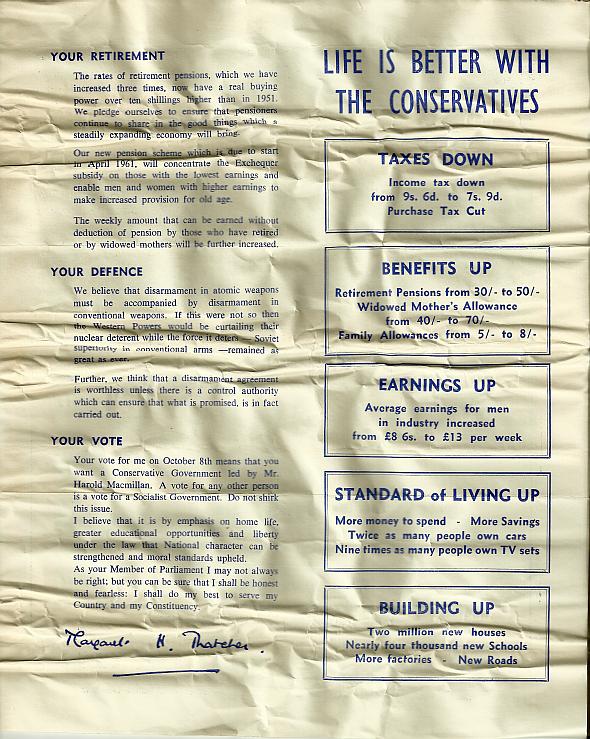
After Margaret Thatcher died, this leaflet from her third (but first successful) parliamentary campaign did the rounds on Twitter:

As an editor, I can't help noticing that there are four pages of the stuff, not to mention the usual assortment of random and pointless capitalisations (some things don't change).

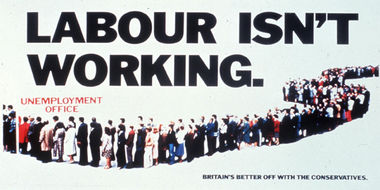
I doubt, by the end of her political career, she would have stood on a platform of 'BENEFITS UP' — but I think, policy aside, it tells us a lot about how political communication changed in the second half of the 20th century.  Fast forward to her leadership of the Conservative Party and her time as prime minister, and compare her first endearingly amateur leaflet with these very influential, clear and direct adverts.  First, the Saatchi campaign that got her elected:


Then the advert I most associate with her time in office, 'AIDS: Don't Die of Ignorance':


We don't tend to think of Thatcher as one of the great political communicators — admirers and detractors both point more to her unshakeable ideology and her force of personality as the secrets of her success — but we might remember how much of the professionalised media management Blair, Mandelson and Campbell perfected in the New Labour era began with her and her press secretary Bernard Ingham.  Perhaps, also, her dislike for nuance, subtlety and intellectual contortion allowed her to present simplified, easily understood messages in a way that has often eluded highbrow leftwing opponents.

The one epitaph being consistently applied by both friends and enemies is that 'you always knew what she stood for'.  In politics I'd prefer to live by Keynes' maxim, and my instincts would always favour consensus over a 51% strategy: but we can't deny the power that the Thatcher brand held for so many people for a remarkably long time.  The appeal of that uncomplicated approach, and the way her image personified her ideas, surely holds lessons for today's corporate and organisational communicators.  Like Supermac, and in a way her biggest rivals Tarzan and the Welsh Windbag never matched, the Iron Lady embraced an opponent's epithet and turned it greatly to her own advantage.

However, I think today marks the moment the brand overreached itself; achieved Thatcheration point.  A ceremonial funeral (a state funeral in all but name), complete with several hundred serving members of the armed forces, a cancellation of PMQs and a silencing of Big Ben, seems to me fitting only for a head of state, not a former head of government.  That conservatives fail to grasp the difference shows the hold she still has on their worldview.

I hope, then, I won't upset anyone by suggesting that now is the time to lay the brand to rest, not to immortalise it.

Wednesday, 27 February 2013

How's that squirty inky stuff workin' out for ya?

I've written a lot in favour of the principles of plain English and Orwellian language generally, so I enjoyed Ed Smith's piece in the New Statesman challenging the ideas the great man laid out in Politics and the English Language. The penultimate paragraph was especially well put:
Orwell argues that the sins of obfuscation and euphemism followed inevitably from the brutalities of his political era. In the age of the atom bomb and the Gulag, politicians reached for words that hid unpalatable truths. By contrast, our era of vague political muddle and unclear dividing lines has inspired a snappy, gritty style of political language: the no-nonsense, evidence-backed, bullet-pointed road to nowhere.
 
It's very hard to disagree with that, particularly with the point about evidence-based policymaking, a phrase often used as a figleaf for policy-based evidencemaking. But I think the wider argument rests on something of a misreading of plain English; of when it needn't be used and when it must.

Any clear and honest communication of a political message is obviously a challenge both to bureaucratic or academic jargon that overcomplicates issues, but less obviously a challenge to the dumbing down that oversimplifies them (which seems often to be confused for plain English). Owen Jones is quite perceptive in noting that the left are particularly guilty on the former score, and the right on the latter: though we could hardly accuse Obama, say, of subxaggerating his backstory.

It's perfectly possible to be insincere with simple, straightforward language. Speaking honestly ought to be just as important as speaking plainly. Finally, it seems to be stating the obvious that plain English is necessary when the writer's primary purpose is to communicate clearly, but might not be when it isn't. A commentor on Stephen Poole's Guardian piece puts it perfectly:
I think you misunderstand the point of plain English a bit (but then in fairness, perhaps some of its adherents do as well). Most people wouldn't expect poetry to be written in plain English. But most people wouldn't expect poetry in a letter from the council, or a bank. Those are the kinds of communication plain English needs to be used in, so that everybody is able to easily understand information that directly affects their lives.
 
Frustrated narcissists in damp garrets are welcome to shovel as much allusion, amphibology and aureation into their fevered, ne'er-to-be-read ramblings and rants as they can manage: but please keep them away from writing letters for HMRC.

Monday, 11 February 2013

Nowt in front of the children

The story about a school in Middlesbrough taking a stern line on non-standard English caught my eye the other day, as did Tom Chivers' take on it.

I agree with Chivers and Wallace that the interests of the learner count most: rightly or wrongly, children will become adults who will be judged on how they speak, and anyone who claims not to judge others by what comes out of their mouths has lies coming out of their own. But I would add that clear communication demands quite a high degree of formalised English. I can (usually, pretty much) understand what any of my fellow Glaswegians are saying to me, but a non-native English-speaking visitor (or even a non-Glaswegian native English speaker) might find himself completely confused by the local vernacular — as when my guest from London was surprised to find two sausages in his 'single sausage' order. Expect plenty of similarly sidesplitting examples of native miscommunication when we host the Commonwealth Games next year.

It's both more considerate and more efficient to be able to speak and write in a recognised and clear form of English. That's not to deny the richness that regional language adds to British culture and the English language; it often saddens me to hear people in parts of East Anglia or the southwest speaking a homogenised estuary English when two generations ago they would have had a distinctly local accent and vocabulary. I don't envy teachers the task of finding the right balance between preserving this heritage while instilling a globally vital form of communication. Perhaps we should count ourselves lucky that, as English speakers, it's only local forms facing extinction, and not our whole language.

There's also a third category of people (usually politicians, academics or middle managers in large organisations) who think that because they don't use local slang they're in command of 'proper' English, but whose idea of communication is to stuff sentences with jargon, obfuscation and words that generally add nothing to the meaning. This often comes down to a lack of intellectual confidence: they imagine that plain English is somehow unsophisticated English, or try too hard to compensate for not having much of interest to say.

The sad truth is that this lack of confidence often stems from something missing in their own schooldays — so perhaps we should applaud anything to prevent the urchins of Middlesbrough becoming the bullshitters of tomorrow.

Tuesday, 15 January 2013

Dearly departed

The Economist has a good blog on airport names this week, pointing out the trend for naming them and other key bits of infrastructure after famous locals. If Birmingham is seriously considering renaming theirs after Ozzy Osbourne, the genre would seem to have jumped the shark.

In Glasgow, we now have the Sir Chris Hoy Velodrome. Clearly, on one level this makes sense, as he is not just Scotland's greatest cyclist but Britain's greatest Olympian (who also has a train named after him already). But there's still something about the trend that bothers me.

It's not just that the man strikes me as modest enough to be embarrassed by it (though we should be thankful for that: imagine if they were naming a stadium after Usain Bolt instead). It's also not just that he hasn't even retired yet (what if he competes there in 2014 and flops?) let alone died, which I think should be a minimum qualification for supplying the name of anything noteworthy. It's not hard to think of examples of famous people who have fallen from public grace towards or soon after the end of their lives or careers — not even hard in the realm of cycling — so the authorities will always be leaving themselves hostage to fortune.

It's not just the aesthetics either: compare JFK with its evocative former name, Idlewild. There may be a case for commemorating a few particularly great individuals — I would grudgingly accept Charles de Gaulle, I suppose — but there's not much poetry to be derived from the names of people. Imagine if every London Underground station were instead named after a well-known local: no more Swiss Cottage, Seven Sisters or Gallions Reach. It would be a sad loss to a small but distinctive part of our culture.

More than that, though, it's the idea that society can't really get along without particular individuals, which seems a depressingly authoritarian view of the world, and one that suggests an ahistorical lack of continuity with past and future generations: with the greatest respect to Sir Chris, soon enough he will mean little more to the latter than he did to the former. Nasty dictators still name not just their buildings but even their days of the week after themselves. Augustus did the same with the calendar in his time.

It seems to me a trend that, if we want to see ourselves as egalitarian and democratic — respectful of our heritage but free-thinking and free-naming — we ought to leave in the departure lounge.

Tuesday, 8 January 2013

Deconstructing dog whistles

Today I noticed a piece of political communication that raised my eyebrows: this one-day poster campaign by the Tories to highlight Labour's support for the government's 1% cap on public sector wage rises (a cut, in real terms) but opposition to the government's 1% cap on rises in benefits.


You might think I'm being pedantic (it is my job, after all) but I think what they've come up with doesn't quite come off.  When you have as few words as this to play with, as will always be the case in a billboard poster, the message needs to be totally unambiguous, and I don't think this is.

The 'by' makes it fall down: it suggests Labour support putting up benefits by an amount greater than workers' salaries, which obviously isn't the case.  On realising it's not the case, the floating voter on the Clapham omnibus might then find himself wondering why the Tories had put up such a misleading poster, and ask himself what else he can't trust them to be straight about.  It also raises the question: which workers?

My suggested wording (assuming that mentioning a 'cap' would be too Westminster villagey) would be as follows: 'Labour want to cut public sector wages. They don't want to cut benefits', perhaps followed by 'Only the Conservatives stand up for hardworking people.'  This leaves out that the government also want to cut public sector wages, so is perhaps a bit more ruthless, but also I think a bit clearer.  Or they could just have gone with 'Today Labour are voting to increase benefits more than public sector wages', or better still "more than nurses' and teachers' wages", if it has to be a one-day-only ad.

Commentators on left and right seem to agree that this is an effective message (as long as the Tories don't overdo it).  It might be a smart political strategy — and if they really can divide the country into 'strivers' and 'skivers' in self-identifying strivers' minds they'll have pulled off quite a propaganda coup — but tactically I'd say they've missed a bit of trick with this effort.

Am I missing the point entirely by trying to deconstruct the dog whistle?  Possibly: my straw man in Clapham might well not get as far as realising that, taken literally, the poster is nonsense.  The strategy, then, relies on confusing voters more than convincing them.  That might work: but why take the risk when a clearer but no less convincing alternative exists?

Sunday, 25 November 2012

Careless communication costs lives

When I first started this blog, I mentioned that I sometimes notice examples of poor communication that aren't just annoying but actively dangerous. Here's an interesting example: a relative of mine was recently given a course of radiotherapy, and was given the timetable I've inserted below.


The last appointment, for some reason, is in black text on a dark purple background that could be quite hard to read and perhaps mistaken for a border and so missed altogether. My relative pointed this out to the nurse, who mentioned that several other people had indeed missed their final radiotherapy sessions (and so, presumably, received an incomplete or delayed dose) as a result of it.

I think we can forgive the initial mistake, but not the failure to fix it once its consequences became clear. The fact that the nurse did nothing to make it more readable makes this report all the more believable. It seems the NHS has some serious problems with communication; unlike with HMRC and other public bodies, the risks are not just to people's time and patience but to their health and lives.

'Poor communication' is very often a political euphemism for a controversial policy poorly implemented, as the NHS recently found with the Liverpool Care Pathway. Here, the ideal scenario would be a sensitive two-way consultation on a complex set of difficult decisions. If this consultation was an intrinsic part of the policy, then the policy failed, even if everything else about the policy was designed and implemented correctly.

Reading those stories, I was reminded of Charles Clarke's claim after the last general election that Labour lost because they'd failed to communicate their message well enough. It apparently hadn't occurred to him that — with the millions spent on press officers, special advisers and widespread advertising — the message had been communicated perfectly well, and that perhaps the real problem was a set of unappealing policies dreamt up by unappealing politicians. (Before I'm accused of any bias, it's worth pointing out that all other parties also lost the last general election, and no doubt for similar reasons but while deploying similar excuses.)

In the case of the LCP, relatives felt the NHS Trusts had failed to consult them properly; in my relative's case, the NHS was similarly inconsiderate in its communications with patients. In each case we can see the potential for slapdash communication — nothing more than the classic failure to fully consider the needs of the person at the receiving end — to cause serious suffering at crucial moments.

I once joked to a paediatrician friend that "if you make a mistake at work children die, but if I make a mistake at work the comma's in the wrong place". I must admit that I hadn't really considered the possibility of children dying because of doctors' inability to put the comma in the right place.

Monday, 12 November 2012

We are all liberals now

With the unsurprising re-election of President Obama, and with voters across the United States endorsing gay marriage and cannabis, we've heard a lot in the last week about the triumph of liberalism. What better time, then, to rid ourselves of an increasingly useless part of the political lexicon?

To a British politics 'n' history graduate like me, the word 'liberal' will always evoke John Stuart Mill's belief that "
the only purpose for which power can be rightfully exercised over any member of a civilized community, against his will, is to prevent harm to others". It also brings to mind the classical liberalism of political economy that began with Adam Smith and continued through Hayek and Friedman: the mantle that today would be claimed by libertarians.

At first, then, the L-word1 meant 'being left alone by the government', as economic liberalism still does in Britain, or as neoliberalism now does around the world. Annoyingly, in many other cases it's often unclear whether it still means that or its opposite. We all like to consider ourselves liberal towards oppressive governments, but have very differing opinions on whether a particular government policy helps freedom (by freeing people from poverty, as the liberal left see it) or hinders it (by interfering in people's business, as the liberal right see it).

The waters got muddier after 1906, as Lloyd George's Liberal government introduced pensions and ramped up taxes on the wealth creators/parasites rich. Ever since then, it's been tricky to work out whether British Liberals and their successor parties are really on the left or the right — whether they want fairness or laissez-faireness — a fudge that recently helped get them back into government, but immediately became a problem again once they got there.

In the United States, 'liberal' is today almost entirely synonymous with 'left-wing'; when someone like Norman Mailer describes himself as a 'left conservative', we might take that to mean a Blue Labour-esque position that is conservative on social issues but left-leaning on the economy. I see no contradiction in that, but it strikes us as unusual because 'liberal' is now so often used to mean both left-wing (economically) and tolerant, permissive, etc (socially).

This also leaves us with the problem of why 'conservative' has become synonymous with right-leaning on the economy, particularly when conserving things is often the last thing on radical rightwing minds. I suppose this politico-linguistic problem really took off when the non-left, in Western countries, abandoned the Keynesian economic consensus in the 1970s.

In Australia, meanwhile, the Liberal Party is the equivalent of the US's Republicans (though they generally oppose a republic) or Britain's Conservatives (who are these days pretty liberal). They might be truest to the low church, small state origins of the idea, but we're left with a word that can mean its complete opposite, depending on the country, the context and no doubt the company.

Should we instead use 'progressive' to describe left-liberals, as many of them do? I would suggest not: any political idea to which no-one could reasonably object (in this case, 'progress') is not an idea at all. Similarly, the left in America seem to take offence at being accused (or take offence on Obama's behalf when he is accused) of 'socialism', a term many in Britain and Europe are still happy to use to describe their own set of beliefs. Might 'social democrat' (now a bit out of fashion in Britain) be less offensive, or does that suggest something more Mailer-ish; too much about responsibilities and not enough about rights? Would 'liberaltarian' be the most honest candidate, or is it just too much of a mouthful?

I suggest we seek guidance from the model offered by the excellent Political Compass, refining right and left economically into whether they are socially liberal or conservative (though even they use the rather loaded term 'authoritarian'; illiberalism and authoritarianism aren't quite the same thing, and there are plenty of constitutional conservatives who would pass as civil libertarians). The top left and bottom right of the compass have always seemed to me the most logical positions — either you accept government interference or social norms to constrain your behaviour or you don't — but that's for another post.

The point is that we have to use these terms with care, and should be quick to ditch them once they become interchangeable. Clarity in our political language might then become our best weapon against the lack of clarity in our political thinking.

1. [I've capped the L because so many sans serif fonts show a lower case l as indistinguishable from an upper case I: another serious failure of communications if you ask me.]