I see the grammar debate is back in the news. Rather tediously, and like so many of these issues, the argument often collapses into two unappealing opposites, when a perfectly sensible and uncontroversial middle ground needn't be beyond our wit.
On the one hand, there is the view that there is no such thing as standard grammar (as argued, rather eliptically, by Michael Rosen) and that, as Charlie Higson puts it, "You can't teach English without teaching grammar, it's inherent." On the other, there is the view that grammar does have fixed rules and that these need to be not just taught but regularly tested.
I argue that one need not be a linguistic prescriptivist with a sort of Euclidean belief in a set of immutable laws — arbitrary archaisms governing when to use 'shall' and when to use 'will', how to not split infinitives, and so on — to recognise the value of having a decent grasp of the forms of sentence structure and orthography commonly used in British English to facilitate clarity in written and spoken communication. The sad reality is that many children will not be exposed to this outside the classroom and will not have them on hand when they first go for an interview. The controversy seems to be about whether teaching critical analysis of Shakespeare, Burns, Orwell and the rest of them will automatically embed a working grasp of these useful conventions, or whether this needs to be done separately and explicitly.
Here comes the smug middle-ground bit, and the plug for my employers. In Scotland, I think we've got the balance about right now. At SQA we've recognised that this osmotic assumption is a bit out of date. That's why we've taken advantage of a new, modular setup to include distinct units in Literacy that will be incorporated into English (and Gàidhlig) courses. In much the same way, we've acknowledged that teaching the -ometries in Maths doesn't necessarily produce numerically competent and confident school-leavers, so we've done the same with Numeracy units. We've also opted to combine continuous coursework with final exams, which again seems to me preferable to a system of assessment based entirely on one or the other.
(Perhaps this is all unnecessary though; the best argument we could present to teenage boys is that a good grasp of grammar will help you get not just jobs but girls.)
It's depressing that this gets hijacked into another interminable left/right argument. By now, we really should be able to agree that if grammatical rules aid clarity and comprehension we should keep them, encourage them, and teach them to children; if not, we shouldn't bother with them. Why we can't just accept this principle then work out the details, rather than turn it into a partisan political debate, is completely beyond me. How many other countries do this?
Perhaps the reason is that, as Chris Cook puts it, "90% of education 'commentary' reflects the writer's own school neuroses." I couldn't possibly comment...
Monday, 13 May 2013

Wednesday, 17 April 2013
The political scientist
After Margaret Thatcher died, this leaflet from her third (but first successful) parliamentary campaign did the rounds on Twitter:
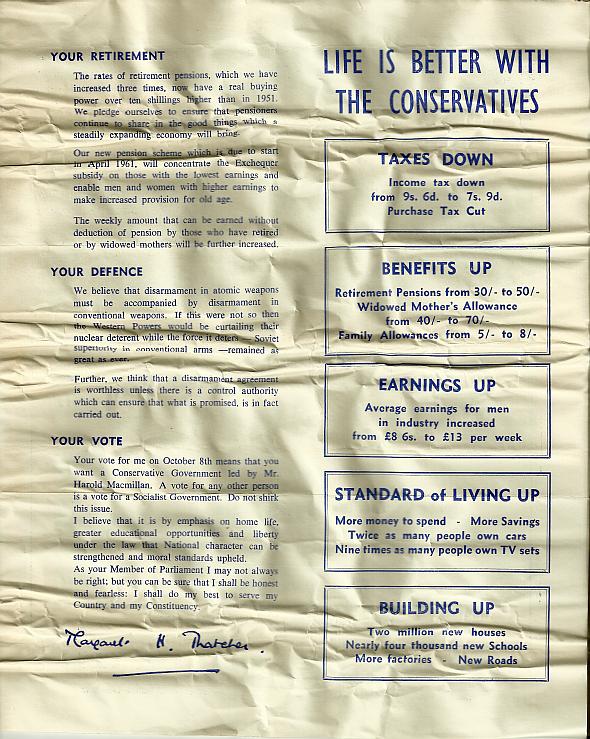
As an editor, I can't help noticing that there are four pages of the stuff, not to mention the usual assortment of random and pointless capitalisations (some things don't change).
I doubt, by the end of her political career, she would have stood on a platform of 'BENEFITS UP' — but I think, policy aside, it tells us a lot about how political communication changed in the second half of the 20th century. Fast forward to her leadership of the Conservative Party and her time as prime minister, and compare her first endearingly amateur leaflet with these very influential, clear and direct adverts. First, the Saatchi campaign that got her elected:
I doubt, by the end of her political career, she would have stood on a platform of 'BENEFITS UP' — but I think, policy aside, it tells us a lot about how political communication changed in the second half of the 20th century. Fast forward to her leadership of the Conservative Party and her time as prime minister, and compare her first endearingly amateur leaflet with these very influential, clear and direct adverts. First, the Saatchi campaign that got her elected:
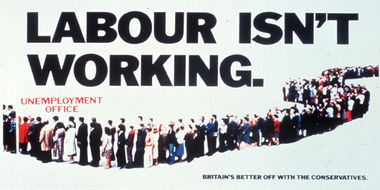
We don't tend to think of Thatcher as one of the great political communicators — admirers and detractors both point more to her unshakeable ideology and her force of personality as the secrets of her success — but we might remember how much of the professionalised media management Blair, Mandelson and Campbell perfected in the New Labour era began with her and her press secretary Bernard Ingham. Perhaps, also, her dislike for nuance, subtlety and intellectual contortion allowed her to present simplified, easily understood messages in a way that has often eluded highbrow leftwing opponents.
The one epitaph being consistently applied by both friends and enemies is that 'you always knew what she stood for'. In politics I'd prefer to live by Keynes' maxim, and my instincts would always favour consensus over a 51% strategy: but we can't deny the power that the Thatcher brand held for so many people for a remarkably long time. The appeal of that uncomplicated approach, and the way her image personified her ideas, surely holds lessons for today's corporate and organisational communicators. Like Supermac, and in a way her biggest rivals Tarzan and the Welsh Windbag never matched, the Iron Lady embraced an opponent's epithet and turned it greatly to her own advantage.
However, I think today marks the moment the brand overreached itself; achieved Thatcheration point. A ceremonial funeral (a state funeral in all but name), complete with several hundred serving members of the armed forces, a cancellation of PMQs and a silencing of Big Ben, seems to me fitting only for a head of state, not a former head of government. That conservatives fail to grasp the difference shows the hold she still has on their worldview.
I hope, then, I won't upset anyone by suggesting that now is the time to lay the brand to rest, not to immortalise it.
Thursday, 11 April 2013
Act in haste, repent in waste
I picked up this slightly al dente leaflet at my work the other day. They were going to get them pulped, but they hate waste more than they hate proofing errors...

Thursday, 21 March 2013
Health prevention of literature
A co-conspirator sent this image in from his place of work:

'It seems like no matter what nationality you are, the slide into stale painting-by-numbers corporate lingo is exactly the same,' he added. Very well put, which is more than we can say for whoever produced the unfortunate poster.
Still, as health advice goes, it's not as disturbing as this sign I saw in Singapore a couple of years ago:

I think that rivals the KEEP OUT: DANGER OF DEATH sign I saw on an electricity substation in Plockton for the least appropriate use of Comic Sans yet.
Friday, 1 March 2013
Tricolon cancer
It seems classical rhetoric has a place in modern communication strategy after all. Have a look at Cancer Research's use of omne trium perfectum in this new poster I saw on the underground this week: I think it works very nicely. They're also taking Owen Jones' advice and telling stories rather than quoting a bunch of boring facts and stuff.

A lot of charities have turned into political lobbying machines and so become distrusted by a jaded public; the more organisations like Cancer Research can show that they stick to their basic purpose, the more they can convince us to fund them. I think campaigns like this will certainly help.
Wednesday, 27 February 2013
How's that squirty inky stuff workin' out for ya?
I've written a lot in favour of the principles of plain English and Orwellian language generally, so I enjoyed Ed Smith's piece in the New Statesman challenging the ideas the great man laid out in Politics and the English Language. The penultimate paragraph was especially well put:
Orwell argues that the sins of obfuscation and euphemism followed inevitably from the brutalities of his political era. In the age of the atom bomb and the Gulag, politicians reached for words that hid unpalatable truths. By contrast, our era of vague political muddle and unclear dividing lines has inspired a snappy, gritty style of political language: the no-nonsense, evidence-backed, bullet-pointed road to nowhere.
It's very hard to disagree with that, particularly with the point about evidence-based policymaking, a phrase often used as a figleaf for policy-based evidencemaking. But I think the wider argument rests on something of a misreading of plain English; of when it needn't be used and when it must.
Any clear and honest communication of a political message is obviously a challenge both to bureaucratic or academic jargon that overcomplicates issues, but less obviously a challenge to the dumbing down that oversimplifies them (which seems often to be confused for plain English). Owen Jones is quite perceptive in noting that the left are particularly guilty on the former score, and the right on the latter: though we could hardly accuse Obama, say, of subxaggerating his backstory.
It's perfectly possible to be insincere with simple, straightforward language. Speaking honestly ought to be just as important as speaking plainly. Finally, it seems to be stating the obvious that plain English is necessary when the writer's primary purpose is to communicate clearly, but might not be when it isn't. A commentor on Stephen Poole's Guardian piece puts it perfectly:
I think you misunderstand the point of plain English a bit (but then in fairness, perhaps some of its adherents do as well). Most people wouldn't expect poetry to be written in plain English. But most people wouldn't expect poetry in a letter from the council, or a bank. Those are the kinds of communication plain English needs to be used in, so that everybody is able to easily understand information that directly affects their lives.
Frustrated narcissists in damp garrets are welcome to shovel as much allusion, amphibology and aureation into their fevered, ne'er-to-be-read ramblings and rants as they can manage: but please keep them away from writing letters for HMRC.
Monday, 11 February 2013
Nowt in front of the children
The story about a school in Middlesbrough taking a stern line on non-standard English caught my eye the other day, as did Tom Chivers' take on it.
I agree with Chivers and Wallace that the interests of the learner count most: rightly or wrongly, children will become adults who will be judged on how they speak, and anyone who claims not to judge others by what comes out of their mouths has lies coming out of their own. But I would add that clear communication demands quite a high degree of formalised English. I can (usually, pretty much) understand what any of my fellow Glaswegians are saying to me, but a non-native English-speaking visitor (or even a non-Glaswegian native English speaker) might find himself completely confused by the local vernacular — as when my guest from London was surprised to find two sausages in his 'single sausage' order. Expect plenty of similarly sidesplitting examples of native miscommunication when we host the Commonwealth Games next year.
It's both more considerate and more efficient to be able to speak and write in a recognised and clear form of English. That's not to deny the richness that regional language adds to British culture and the English language; it often saddens me to hear people in parts of East Anglia or the southwest speaking a homogenised estuary English when two generations ago they would have had a distinctly local accent and vocabulary. I don't envy teachers the task of finding the right balance between preserving this heritage while instilling a globally vital form of communication. Perhaps we should count ourselves lucky that, as English speakers, it's only local forms facing extinction, and not our whole language.
There's also a third category of people (usually politicians, academics or middle managers in large organisations) who think that because they don't use local slang they're in command of 'proper' English, but whose idea of communication is to stuff sentences with jargon, obfuscation and words that generally add nothing to the meaning. This often comes down to a lack of intellectual confidence: they imagine that plain English is somehow unsophisticated English, or try too hard to compensate for not having much of interest to say.
The sad truth is that this lack of confidence often stems from something missing in their own schooldays — so perhaps we should applaud anything to prevent the urchins of Middlesbrough becoming the bullshitters of tomorrow.
Subscribe to:
Posts (Atom)