Friday, 26 July 2013

The open society and its enemies

Thrill-a-minute hedonist that I am, I've spent the week reading Facts are Sacred, the Guardian's new book on data journalism, and The Signal and the Noise by clever clogs Nate Silver. The usual low standards of Guardian subbing are met, but ignoring that there's some interesting content. I note that the New Statesman, New Scientist and several marketing magazines have also devoted recent front covers to big data.

Nate Silver is impressive on the limitations of data; what he really advocates is an approach combining both quantitative and qualitative analysis, as well as a Bayesian method of improving one's probabilistic forecasts as the evidence changes. His advice — again, equally applicable to anyone in business, politics, communications or journalism — is to be consciously aware of your own biases if you want to overcome them and see the situation objectively. You hardly need me to add to the mountains of textbooks already written on how institutional groupthink and inertia have brought down many once-mighty companies. The challenge is to constantly apply this scepticism to your own positions.

At the risk of coming over all Blairite, there is also an open/closed distinction at work here, and the point applies as much to mindsets as datasets — and it cuts completely across traditional left/right or even liberal/conservative lines. As a recent Economist piece put it: "Our ideological sympathies are not good predictors at this point of how we feel about issues of digital privacy and electronic freedom. The fact that these issues don't have a clear ideological colouration yet is important because they are among the most crucial issues of the 21st century."

I would summarise this as the division between those whose instinct is to make information more widely available, and those whose instinct is that it should remain the preserve of responsible gatekeepers of knowledge — between:


We could list more examples, but the point is that this battle against banal illiberalism will define the era of big data and big brothers. Those of us working in communications are at the frontline, so we might as well get ourselves on the right side. If you're a journalist: understand how data can be used both to find and to illustrate stories, carefully craft and submit FOIs,1 resist the lure of churnalism; if you're in PR or marketing, convince your bosses to make openness and clarity an integral part of your brand, develop a responsive social media presence that makes this a reality, and never let the cover-up eclipse the crime.

As YouGov's Peter Kellner says: "knowledge is not only preferable to ignorance in principle; it also makes for a healthier society in practice". Encouragingly, one of the 10 design principles on the new gov.uk site is: "Make things open: it makes things better." What we really need is for this message to filter up to ministers and senior civil servants, and down to middle managers.

The point isn't that we need to be anti-capitalist or anti-government in principle; just that, to make both of these essential parts of our society work better, we need to keep a close eye on them from inside and out. As citizens we have to hold public bodies and global companies to account every bit as ruthlessly as we hold producers to account when we choose whether or not to buy their goods and services. As employees we need to fight institutional cultures that prioritise the organisation above the consumer or the public.

Erring on the side of this openness is good for society; whether it's good for individuals is an entirely different question.

1 I recently did this in my capacity as an elected member of Dowanhill, Hyndland and Kelvinside Community Council, and after waiting nearly a month was told by Glasgow City Council I'd need to pay a fee of £90 to get the answer I was looking for. But don't let that put you off. ;-)

Thursday, 20 June 2013

What a tangled website we weave

I've written favourably about the new gov.uk site before, and this week I see they've also published their style guide and content guidelines.

For comparison, here's the house style and plain English guide I helped write for my present employers. The Economist, Guardian and BBC style guides are also useful reference points, particularly for anyone coming in to an organisation that hasn't yet developed its own rules.

This latest addition is an impressive bit of work: most of it accords with what we're already doing in our publications, and while there a few points I would quibble with (they advise against writing out numbers below 10, for instance) there are certainly a few more we could incorporate (eg on SEO).

It would be nice to see this applied consistently across the whole public sector and its sub-guides; gov.uk could act as a sort of BSI for these (though I'm not sure what my pals at Hansard would make of that). If David Cameron's looking for a house style tsar, I hereby throw my hat into the ring.

Thursday, 6 June 2013

Hearts and minds

Victoria Macdonald at Channel 4 News had a good blog post on jargon in healthcare communications yesterday. She suggests that the political challenge of reorganising the NHS might be a lot simpler for managers and civil servants, if only they communicated with a suspicious public in something nearer plain English:

"Those speaking for change did not argue their case particularly well and at times seemed either exasperated or even patronising. I know they did not mean to come across that way but years of reporting the NHS has shown me that often those working in the health service do not know how to speak plain English and regularly fall back on jargon as well as making assumptions that people and patients know as much as they do about complicated statistical models of health care."
As well as helping to win arguments like these, taking clear communication more seriously could save lives. The approach of a senior manager at one of my employers — "if you can't convince them, confuse them" — seems, sadly, just as common in the healthcare sector as everywhere else.

Friday, 24 May 2013

The next large scale innovator disruptor in the quickly dying education market?

A pal writes in:

"Not sure you'll get all this — you need to read the pompous piece it's responding to but I thought it was such a hilarious pricking of a balloon that I thought you should point to it in your blog."

Done!

Monday, 13 May 2013

Testing, testing

I see the grammar debate is back in the news.  Rather tediously, and like so many of these issues, the argument often collapses into two unappealing opposites, when a perfectly sensible and uncontroversial middle ground needn't be beyond our wit.

On the one hand, there is the view that there is no such thing as standard grammar (as argued, rather eliptically, by Michael Rosen) and that, as Charlie Higson puts it, "You can't teach English without teaching grammar, it's inherent."  On the other, there is the view that grammar does have fixed rules and that these need to be not just taught but regularly tested.

I argue that one need not be a linguistic prescriptivist with a sort of Euclidean belief in a set of immutable laws — arbitrary archaisms governing when to use 'shall' and when to use 'will', how to not split infinitives, and so on — to recognise the value of having a decent grasp of the forms of sentence structure and orthography commonly used in British English to facilitate clarity in written and spoken communication.  The sad reality is that many children will not be exposed to this outside the classroom and will not have them on hand when they first go for an interview.  The controversy seems to be about whether teaching critical analysis of Shakespeare, Burns, Orwell and the rest of them will automatically embed a working grasp of these useful conventions, or whether this needs to be done separately and explicitly.

Here comes the smug middle-ground bit, and the plug for my employers.  In Scotland, I think we've got the balance about right now.  At SQA we've recognised that this osmotic assumption is a bit out of date.  That's why we've taken advantage of a new, modular setup to include distinct units in Literacy that will be incorporated into English (and GĂ idhlig) courses.  In much the same way, we've acknowledged that teaching the -ometries in Maths doesn't necessarily produce numerically competent and confident school-leavers, so we've done the same with Numeracy units.  We've also opted to combine continuous coursework with final exams, which again seems to me preferable to a system of assessment based entirely on one or the other.

(Perhaps this is all unnecessary though; the best argument we could present to teenage boys is that a good grasp of grammar will help you get not just jobs but girls.)

It's depressing that this gets hijacked into another interminable left/right argument.  By now, we really should be able to agree that if grammatical rules aid clarity and comprehension we should keep them, encourage them, and teach them to children; if not, we shouldn't bother with them.  Why we can't just accept this principle then work out the details, rather than turn it into a partisan political debate, is completely beyond me.  How many other countries do this?

Perhaps the reason is that, as Chris Cook puts it, "90% of education 'commentary' reflects the writer's own school neuroses."  I couldn't possibly comment...

Wednesday, 17 April 2013

The political scientist

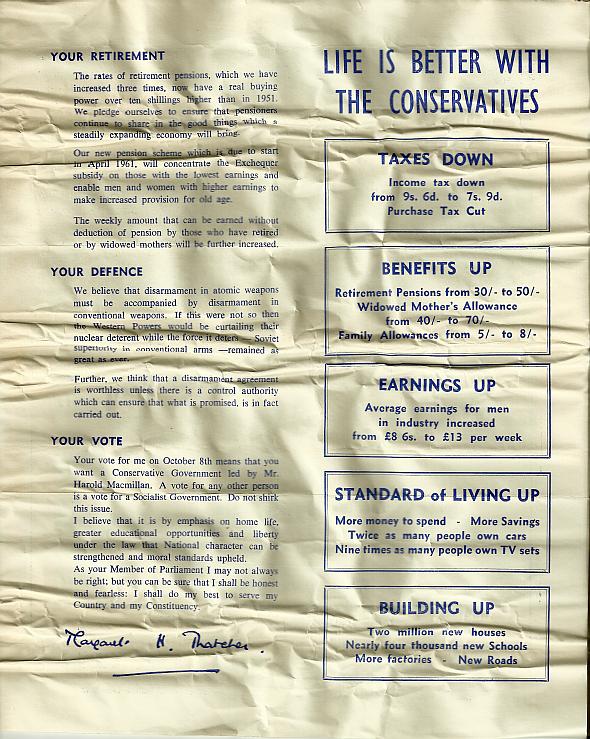
After Margaret Thatcher died, this leaflet from her third (but first successful) parliamentary campaign did the rounds on Twitter:

As an editor, I can't help noticing that there are four pages of the stuff, not to mention the usual assortment of random and pointless capitalisations (some things don't change).

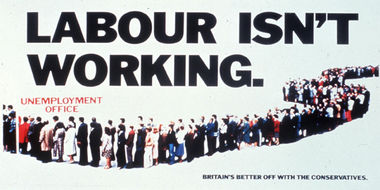
I doubt, by the end of her political career, she would have stood on a platform of 'BENEFITS UP' — but I think, policy aside, it tells us a lot about how political communication changed in the second half of the 20th century.  Fast forward to her leadership of the Conservative Party and her time as prime minister, and compare her first endearingly amateur leaflet with these very influential, clear and direct adverts.  First, the Saatchi campaign that got her elected:


Then the advert I most associate with her time in office, 'AIDS: Don't Die of Ignorance':


We don't tend to think of Thatcher as one of the great political communicators — admirers and detractors both point more to her unshakeable ideology and her force of personality as the secrets of her success — but we might remember how much of the professionalised media management Blair, Mandelson and Campbell perfected in the New Labour era began with her and her press secretary Bernard Ingham.  Perhaps, also, her dislike for nuance, subtlety and intellectual contortion allowed her to present simplified, easily understood messages in a way that has often eluded highbrow leftwing opponents.

The one epitaph being consistently applied by both friends and enemies is that 'you always knew what she stood for'.  In politics I'd prefer to live by Keynes' maxim, and my instincts would always favour consensus over a 51% strategy: but we can't deny the power that the Thatcher brand held for so many people for a remarkably long time.  The appeal of that uncomplicated approach, and the way her image personified her ideas, surely holds lessons for today's corporate and organisational communicators.  Like Supermac, and in a way her biggest rivals Tarzan and the Welsh Windbag never matched, the Iron Lady embraced an opponent's epithet and turned it greatly to her own advantage.

However, I think today marks the moment the brand overreached itself; achieved Thatcheration point.  A ceremonial funeral (a state funeral in all but name), complete with several hundred serving members of the armed forces, a cancellation of PMQs and a silencing of Big Ben, seems to me fitting only for a head of state, not a former head of government.  That conservatives fail to grasp the difference shows the hold she still has on their worldview.

I hope, then, I won't upset anyone by suggesting that now is the time to lay the brand to rest, not to immortalise it.

Thursday, 11 April 2013

Act in haste, repent in waste

I picked up this slightly al dente leaflet at my work the other day. They were going to get them pulped, but they hate waste more than they hate proofing errors...